
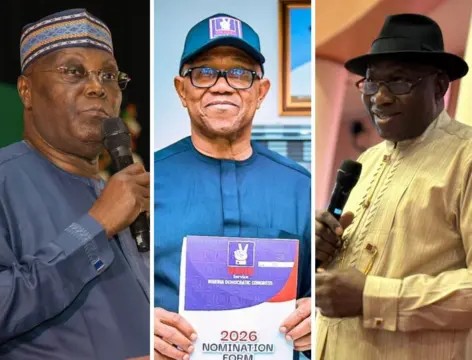
No To 2027 Elections Until Nigeria’s Urgent Questions Answered
The greatest mistake Nigeria’s opposition can make today is to behave as though the next election is the nation’s most urgent problem.
It is not.
The most urgent problem is the condition of the Nigerian state itself.
Every day, opposition leaders gather to discuss coalitions, defections, alliances, zoning formulas and presidential tickets. Yet millions of Nigerians are asking a different question:
What are you doing about the crises confronting the nation right now?

A credible opposition must be more than a collection of politicians seeking power. It must become the voice of the people and the conscience of the nation.
Before any serious discussion of 2027, the opposition should unite around the following demands.
1. WHERE ARE THE KIDNAPPED CHILDREN?
Nigeria cannot be discussing elections while innocent children remain in captivity.
The continued kidnapping of school children and minors is a national disgrace.
The opposition should make the rescue and safe return of every kidnapped child a non-negotiable national priority.
The government must provide regular updates on rescue efforts and security strategies.
No nation should normalize the abduction of its children.
No responsible opposition should move on as if nothing has happened.
2. WHY HAS CONFIDENCE IN INEC COLLAPSED?
The foundation of democracy is trust.
When confidence in the electoral process declines, democracy itself becomes endangered.
The opposition should demand comprehensive electoral reforms capable of restoring public confidence in the electoral system.
The question is simple:
How can Nigerians confidently discuss another election when many citizens remain unconvinced that previous concerns regarding electoral transparency have been adequately addressed?
Until public confidence is restored, election discussions remain premature.
3. WHY HAS THE INEC CHAIRMAN NOT ACCEPTED RESPONSIBILITY FOR THE CONTROVERSIES SURROUNDING THE ELECTORAL PROCESS?
Leadership carries responsibility.
Institutions earn public confidence through accountability.
Where serious questions arise regarding the conduct, management or credibility of elections, accountability must follow.
The opposition should insist that those entrusted with safeguarding democracy be held to the highest standards of transparency and responsibility.
Democracy cannot thrive where accountability is absent.
4. QUESTIONS SURROUNDING THE TREATMENT OF MALLAM NASIR EL-RUFAI MUST BE ADDRESSED
The opposition must speak with one voice whenever concerns arise regarding the treatment of opposition figures.
Whether one agrees or disagrees with Mallam El-Rufai’s politics is irrelevant.
The principle at stake is larger than any individual.
The Nigerian people deserve assurance that state institutions are not being used selectively against political opponents and critics.
The opposition must consistently demand due process, fairness and equal treatment under the law.
Democracy cannot flourish where political rivalry is perceived as a basis for unequal treatment.
5. THE CONSTITUTION MUST NOT BE SELECTIVELY APPLIED
Questions have been raised concerning the qualification and emergence of certain political actors, including former House Minority Leader O.K. Chinda.
Where constitutional concerns exist, they should not be ignored because of political convenience.
The Constitution must apply equally to everyone.
The opposition should insist that all public officials and candidates be subjected to the same legal and constitutional standards.
No democracy survives when constitutional compliance becomes optional.
6. THE WARRI DELINEATION CONTROVERSY MUST BE TRANSPARENTLY RESOLVED
The controversy surrounding the delineation of polling units and electoral boundaries affecting Urhobo, Itsekiri and Ijaw communities has raised serious national concerns.
This matter goes beyond Delta State.
It touches the integrity of Nigeria’s democratic institutions.
The opposition should demand full public disclosure of the legal basis, methodology, consultations and data that informed the exercise.
Equally important are questions regarding the proper constitutional roles of public institutions.
INEC is constitutionally empowered to conduct electoral activities.
Security agencies have their own constitutional responsibilities.
The Office of the First Lady is not a constitutionally recognized executive institution with powers over electoral matters.
Therefore, any perception that electoral decisions are being influenced by actors outside the constitutional framework must be transparently addressed.
The Nigerian people deserve answers.
Who directed the process?
Who supervised it?
What role did security agencies play?
Were constitutional boundaries respected?
These questions must be answered openly and credibly.
7. WHAT HAPPENED TO THE FIGHT AGAINST INSECURITY?
Large portions of Nigeria continue to experience kidnappings, banditry, terrorism and violent crime.
Farmers are abandoning their farms.
Communities are living in fear.
Citizens are paying ransoms to criminals.
Yet political leaders are already campaigning for offices they do not yet occupy.
The opposition must force security and governance issues to the centre of national discourse.
8. NIGERIANS ARE SUFFERING ECONOMICALLY
The economic realities confronting Nigerians are severe.
Food inflation remains high.
The cost of living continues to rise.
Small businesses are struggling.
Young Nigerians are increasingly uncertain about their future.
The opposition should devote more energy to presenting alternative economic solutions than discussing political permutations.
Power must never become more important than the people.
NO TO POLITICS AS USUAL
The opposition must understand that Nigerians are tired.
Tired of insecurity.
Tired of economic hardship.
Tired of institutional weakness.
Tired of politicians who become activists only when elections approach.
The task before the opposition is clear.
Before talking about coalitions.
Before discussing zoning.
Before negotiating tickets.
Before planning campaigns.
The nation deserves answers to these questions:
Where are the kidnapped children?
Why do Nigerians still feel unsafe?
Why has confidence in electoral institutions deteriorated?
Why do constitutional controversies remain unresolved?
Why are concerns regarding opposition figures and due process not adequately addressed?
What exactly happened in the Warri delineation exercise?
Why are ordinary Nigerians carrying the burden of economic pain?
Until these questions are answered, the debate about 2027 is secondary.
The road to the next election must begin with accountability.
The road to accountability must begin now.
History will not remember who formed the biggest coalition.
History will remember who stood up when Nigeria needed courage, truth and leadership.
Cc: Atiku Abubakar
Peter Obi


