
Adeleye Falade and the NLNG Reset: How Industry Experience, Advocacy and Strategic Engagement Are Repositioning the Gas Giant
Since assuming office as Managing Director and Chief Executive Officer of the Nigeria Liquefied Natural Gas Limited (NLNG) in April 2026, Adeleye “Leye” Falade has begun to imprint a leadership approach that appears to combine technical industry experience with deliberate stakeholder engagement, policy advocacy and a more clearly articulated national-development narrative.
It is still relatively early to make a definitive assessment of his tenure. However, developments and public engagements between April and September 2026 provide enough evidence to identify the emerging direction of the Falade administration.

At the centre of that direction is a straightforward proposition: NLNG’s future growth depends not merely on building more LNG capacity, but on securing gas supply, improving plant utilisation, strengthening domestic energy access, deepening Nigerian participation and aligning the company’s commercial objectives with Nigeria’s wider economic interests.
That approach is particularly significant because Falade is not coming into the job as an outsider.
An Insider with International Oil and Gas Experience
Falade brings nearly three decades of experience across the oil and gas industry, with exposure to upstream and midstream operations, LNG production, engineering, production optimisation, operational excellence and business transformation.
Before returning to NLNG as MD/CEO, he was Managing Director of Brunei LNG, following a stint as Shell Namibia Country Chair. Earlier, he spent several years at NLNG itself, including as Operations Manager and later General Manager, Production, overseeing plant performance, reliability and operational safety at Bonny Island.

That history matters because one of NLNG’s most important challenges is not simply the construction of additional infrastructure. It is the interaction between upstream gas availability, pipeline security, plant utilisation, LNG production, international contracts and domestic energy requirements.
Falade has experience on several sides of that equation.
His return therefore gives him institutional knowledge of NLNG’s production system, while his international assignments provide exposure to how major LNG businesses operate in competitive global markets. His previous leadership at Brunei LNG is particularly relevant to his current mandate because it involved managing an established LNG producer outside Nigeria’s operating environment.
From Plant Floor to National Policy Conversations
One of the clearest features of Falade’s early tenure has been the frequency and range of his engagement with institutions capable of influencing NLNG’s operating environment.
Within months of assuming office, he engaged the Nigerian Upstream Petroleum Regulatory Commission (NUPRC) on the question of sustainable gas supply.


The meeting was significant because NUPRC regulates the upstream environment from which NLNG obtains much of the feed gas required for its operations.
Falade stressed the importance of upstream collaboration, while NUPRC leadership emphasised regulatory reforms, industry responsiveness and the need to expand gas production. Falade also highlighted NLNG’s domestic LPG strategy, noting that all of the company’s LPG production was then being directed to the domestic market.
This represents a shift from treating NLNG primarily as an LNG exporter to presenting it as part of a broader gas-value-chain ecosystem.
The Feed-Gas Problem is Being Placed at the Centre
Perhaps the clearest example of Falade’s policy articulation came during his September 2026 engagement with the international energy community at Gastech 2026.
He reported that NLNG’s plant utilisation had improved from roughly 60 per cent over the preceding two years to approximately 82–83 per cent.
But rather than presenting increased utilisation as the end of the problem, he identified reliable gas supply as the next critical constraint.
Falade said plant availability was no longer the principal limitation and that the focus had consequently shifted toward securing sufficient gas to sustain production and meet contractual commitments. He also pointed to a reduction in pipeline incursions and continued engagement with existing and new gas suppliers.
That is an important distinction. It suggests that the emerging management strategy recognises that Train 7 alone cannot transform NLNG’s output if the company cannot reliably feed the trains with gas.


Train 7: Moving from Construction to Utilisation
Train 7 remains the flagship expansion project under the company’s current growth trajectory.
The project is expected to increase NLNG’s production capacity by about 35 per cent, taking the company from six to seven trains when operational.
Falade’s public messaging, however, has increasingly connected Train 7 to the wider gas-supply question.


At Gastech, he reported that Train 7 was approximately 93–94 per cent complete, with engineering virtually complete and construction completed, while remaining work was concentrated largely around commissioning and start-up preparations. He said NLNG’s aspiration was to have the plant ready for start-up by the end of 2027, subject to safe commissioning and sufficient gas availability.
The distinction is important: capacity expansion is being framed together with feed-gas security and operational reliability.
Advocacy at the highest level

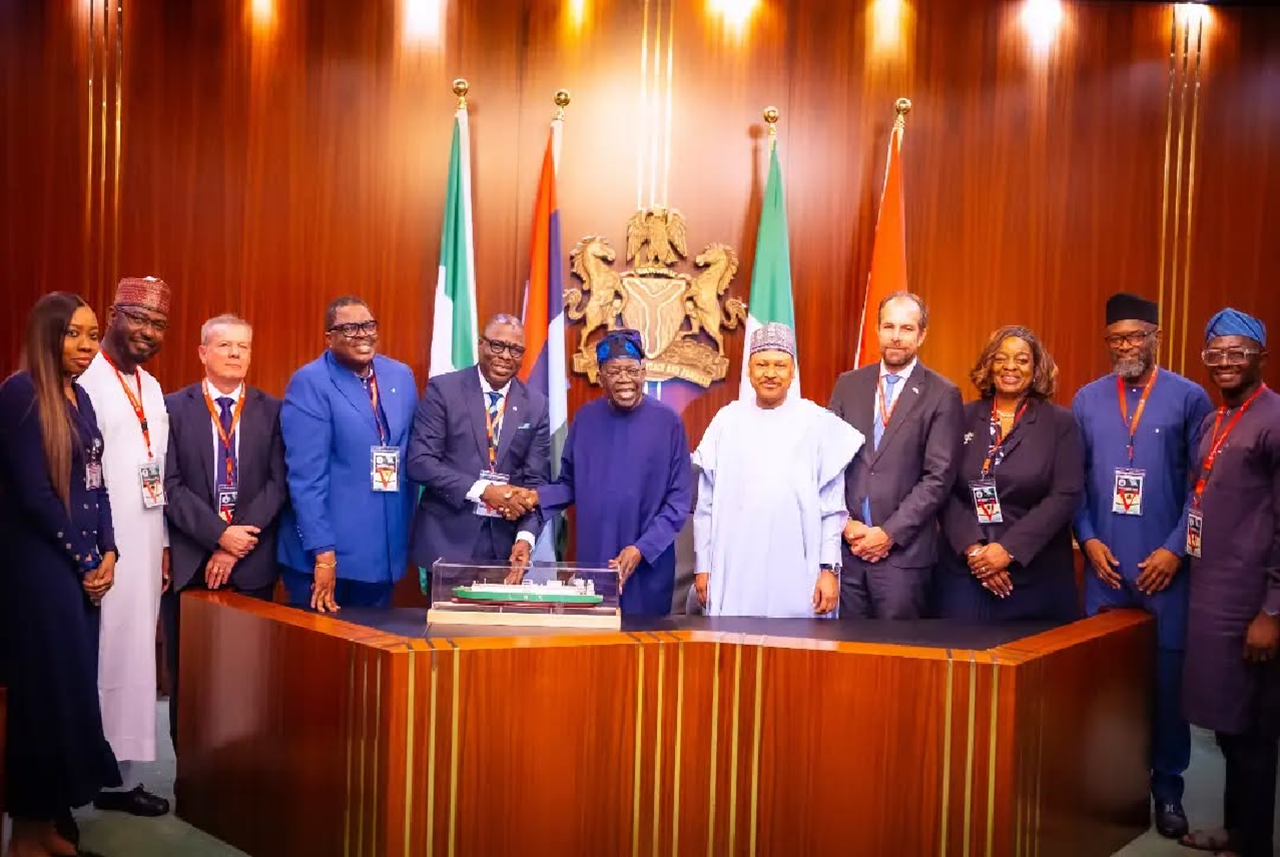
Falade’s engagement with President Bola Ahmed Tinubu in August also demonstrated the increasingly direct nature of his advocacy.
Leading the NLNG Board to the State House, he presented the company not merely as a commercial LNG producer but as a strategic national asset.
He told the President that NLNG had generated more than $150 billion since inception, with shareholders, including the Nigerian government, receiving approximately $47 billion in dividends. He also explained the relationship between crude-oil production, gas availability and NLNG’s plant utilisation.

The engagement also placed domestic LPG, Train 7, gas production and infrastructure development within the same conversation.
President Tinubu, in response, specifically challenged NLNG to increase domestic utilisation of Nigeria’s gas resources and reduce gas flaring.

This exchange illustrates an important dimension of Falade’s approach: advocacy is being used to connect NLNG’s operational requirements with government policy priorities.
Rather than treating government as simply a shareholder or regulator, the emerging model positions government as a strategic partner in solving upstream, security, infrastructure and investment constraints.
Security as an Energy-Policy Issue
Falade’s engagement with the Ministry of Defence provides another example.
In May, he led an NLNG delegation to meet Defence Minister Christopher Musa over the protection of critical energy infrastructure.
The discussion focused on the security of NLNG’s operations, maritime safety and the wider upstream supply chain. Falade specifically linked disruptions in the upstream chain to national output and stressed that protecting NLNG’s expansion was essential to meeting both shareholder and national economic expectations.
This is significant because it broadens the conversation around LNG production. Gas security is ultimately infrastructure security, maritime security and upstream security.
By taking that argument directly to the defence establishment, Falade has demonstrated an advocacy style that seeks to bring different arms of government into the operational problems confronting the company.


Local Content Beyond Compliance
Another emerging feature is the emphasis on Nigerian Content.
In June, Falade visited the Nigerian Content Development and Monitoring Board (NCDMB), where both institutions recommitted themselves to deepening Nigerian participation in NLNG’s value chain.
Falade identified vendor development, skills enhancement, technology transfer, local procurement and value retention as areas for practical collaboration. At the time, NCDMB reported that Train 7 had reached about 90 per cent completion and that pre-commissioning activities had begun.
The engagement subsequently extended into human-capital development, including collaboration around research and industry-oriented skills development.
This suggests that the emerging strategy is not limited to “build Train 7”, but increasingly asks what economic ecosystem should surround the project.
Domestic LPG: Exporting LNG while serving Nigeria
Perhaps the most visible expression of Falade’s domestic-policy emphasis is LPG.
NLNG says its domestic LPG programme is designed to make cleaner cooking energy more accessible to Nigerian households.
Falade has repeatedly placed domestic LPG in his public engagements.
In September, he stated that NLNG was supplying approximately 500,000 tonnes of LPG annually, which he said represented about 40 per cent of Nigeria’s domestic LPG supply.
This is strategically important because it gives the company’s gas narrative a domestic dimension.
The emerging message is that Nigeria’s gas resources should simultaneously support:
- LNG exports;
- government revenue;
- domestic cooking energy;
- industrial development;
- local businesses;
- employment;
- and future gas-based economic activity.
That broader framing appears consistent with President Tinubu’s call for greater domestic utilisation of gas.
Foreign Affairs and Economic Diplomacy
Falade has also begun positioning NLNG within Nigeria’s international economic diplomacy.
In June, he led an NLNG delegation to the Ministry of Foreign Affairs, where discussions centred on NLNG’s role in attracting investment, strengthening international partnerships and projecting Nigeria’s economic interests.
Falade described NLNG as an important ambassador of Nigeria’s economic potential and highlighted Train 7’s potential to increase production from approximately 22 million tonnes per annum to about 30 million tonnes when completed.
The significance is that LNG is being presented not simply as an energy commodity but as a diplomatic and investment asset.
That is consistent with Falade’s international background and his previous experience managing energy businesses outside Nigeria.
A More Deliberate Communication Strategy
There is also evidence of an effort to make NLNG’s strategy more accessible to the public and industry stakeholders.
At a 2026 media engagement around NLNG’s Facts and Figures, journalists had direct interaction with Falade and an opportunity to question him about the company’s operations and direction. NLNG’s External Relations leadership described timely, accurate and contextual information as important to credible journalism.


His Gastech engagement further demonstrated a willingness to explain the company’s constraints in relatively straightforward operational terms: utilisation has improved; gas supply remains critical; Train 7 is approaching completion; and future growth depends on reliability, supply and execution.
That clarity is useful because it reduces a complex corporate strategy to identifiable operational priorities.
What, then, is the Falade model?
The evidence from his first months in office points toward five interconnected priorities:
| Emerging priority | Evidence of approach |
|---|---|
| Secure feed gas | Direct engagement with NUPRC, suppliers and upstream stakeholders |
| Complete and utilise Train 7 | Linking expansion to gas availability and commissioning readiness |
| Expand domestic gas value | Strong emphasis on LPG and domestic utilisation |
| Strengthen Nigerian participation | NCDMB engagement around vendors, skills, technology and local procurement |
| Build strategic institutional alliances | Engagements with Presidency, NUPRC, NCDMB, Defence, Foreign Affairs and industry stakeholders |
The common denominator is strategic engagement rather than isolated corporate communication.
Falade’s background appears to be particularly relevant here. An executive who has worked in operations at NLNG, production leadership at Bonny Island, global asset-management systems, Shell’s international operations and the leadership of Brunei LNG has exposure to the technical, commercial and stakeholder dimensions of the LNG business.
The Bonny-Bodo Dimension
His engagement with the President also provided an opportunity to highlight the completion of the Bonny-Bodo Road and Bridge, financed by NLNG and awaiting official commissioning at the time of the August meeting.
The project is relevant to the wider argument about NLNG’s social licence and economic footprint in its host environment.
NLNG’s own sustainability reporting identifies infrastructure, healthcare, education, community development and economic empowerment among its areas of intervention.
Under Falade, however, the challenge will be to demonstrate how such interventions connect with a broader economic-development strategy rather than existing merely as individual corporate-social-investment projects.
The Early Verdict: A Shift in Emphasis
It would be premature to describe six months of leadership as a completed transformation of NLNG. Many of the company’s major programmes, including Train 7, predate Falade’s tenure.
What can reasonably be observed is a shift in emphasis and articulation.
Falade appears to be placing greater emphasis on connecting NLNG’s commercial objectives with the conditions necessary for long-term growth: reliable upstream gas, regulatory cooperation, security, domestic LPG supply, Nigerian Content, international investment, government partnership and disciplined execution.
His antecedents are central to this approach.
He knows the NLNG plant from the operational side. He has worked across the broader petroleum value chain. He has managed an LNG company abroad. He has operated within Shell’s international system. And he has experience engaging stakeholders in different regulatory and political environments.
That combination is now being deployed in a leadership style that is increasingly visible through advocacy, institutional engagement and policy clarity.
The bigger test will be whether these engagements translate into sustained increases in gas availability, reliable operation of all seven trains, completion and commissioning of Train 7, stronger domestic LPG penetration, greater Nigerian value retention and measurable economic returns.
For now, the direction is becoming clearer:
Falade is not presenting NLNG’s next phase simply as an LNG production expansion. He is framing it as a wider gas-value-chain and national-development proposition — with NLNG at the centre of Nigeria’s effort to turn its gas resources into greater economic value.


