
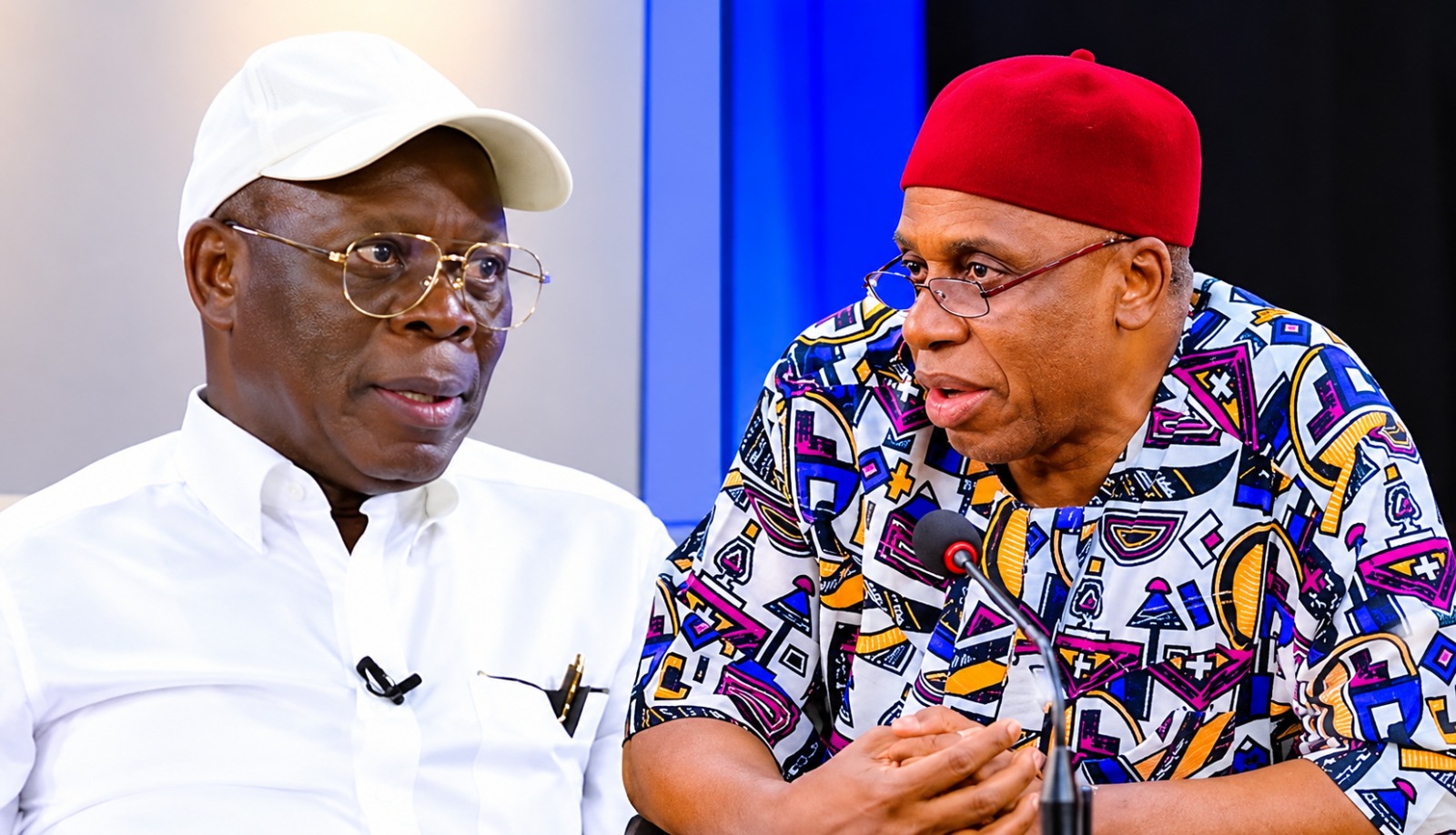
Amaechi Flaunts Academic Credentials, Challenges Oshiomhole to Publish His
The debate over public disclosure of the educational qualifications of Nigeria’s political officeholders has received fresh attention following a challenge by former Rivers State Governor, Rotimi Amaechi, to the Senator representing Edo North Senatorial District, Adams Oshiomhole, to make his academic certificates public.
Amaechi, the African Democratic Congress (ADC) vice presidential candidate, issued the challenge during an interview on Rapid TV, where he responded to Oshiomhole’s description of him as “shallow” and “unreliable”.

Defending his academic background, the former Governor and two-term Minister of Transportation under the late President Muhammadu Buhari listed several qualifications, including degrees in Law and Literature, master’s degrees in both disciplines, a certificate from the University of London and a master’s degree from King’s College London.
He also disclosed that he was pursuing another master’s degree in Global Political Economy.
“He said I’m shallow, but I hold degrees in Law and Literature, Master’s degrees in both fields, and a certificate from the University of London. I also have a Master’s degree from King’s College London, and I’m pursuing a Master’s degree in Global Political Economy,” Amaechi said.
He then challenged the former Edo State Governor to make his own academic credentials public, saying: “Tell him to show his certificate.”
The exchange followed Oshiomhole’s criticism of Amaechi’s political positions, particularly his attacks on the All Progressives Congress (APC) and President Bola Tinubu, despite his previous association with the ruling party.

Oshiomhole had also questioned Amaechi’s credibility over his relationship with former Vice President Atiku Abubakar, the ADC presidential candidate.
He recalled that Amaechi had previously challenged Atiku’s emergence as presidential candidate of the Peoples Democratic Party (PDP), describing the process as fraudulent, before subsequently agreeing to work with him.
But Amaechi attributed Oshiomhole’s criticism partly to his role in the former Edo State Governor’s removal as APC national chairman.
“What is paining Oshiomhole is that he was removed as Chairman of the party, and I led the team that removed him as Chairman of the party because he was incapable of governing the party,” he said.
Amaechi also recalled that Oshiomhole was among the governors who supported his emergence as Chairman of the Nigeria Governors’ Forum, questioning why the senator would now describe him as shallow.
The former Rivers State Governor further rejected Oshiomhole’s allegations that his administration mismanaged public funds and abandoned projects, questioning why the claims were being raised approximately 12 years after he left office.
“It took him 12 years. Nigeria has not asked questions. Twelve years to accuse me and falsely. He didn’t say it as I left office, he didn’t say it one year after, two years after, three years after. Why now?” Amaechi asked.
The exchange has brought renewed attention to calls for greater transparency in the academic records of public officeholders, particularly amid recurring controversies over the qualifications declared by political figures in Nigeria.
Beyond the political contest between the two former governors, the issue raises a broader question about the responsibility of elected officials and political appointees to make their educational claims accessible to public scrutiny.
The Federal Ministry of Education announced in April 2026 that the authentication and evaluation of academic credentials had been digitised, with applicants required to upload supporting documents and request transcripts directly from awarding institutions for verification. The reform is aimed at strengthening the integrity and credibility of academic records.
However, the distinction between verifying a qualification and voluntarily publishing one’s certificates remains important. Public disclosure allows citizens and journalists to scrutinise claims, while authentication by the relevant institutions establishes whether the documents are genuine.
Amaechi’s challenge to Oshiomhole has therefore added a new dimension to the debate: whether public officeholders should go beyond declaring their qualifications and proactively make verifiable evidence available to Nigerians.
Neither the exchange nor Amaechi’s challenge, on its own, establishes that either politician’s academic credentials are invalid. The central issue remains the need for credible verification, transparency and accountability in the educational claims made by those seeking or occupying public office.


