
Adopt NLNG Model to Revive PH Refinery – Expert Tells FG
A Professor of Chemical Engineering at the Rivers State University (RSU), Kenneth Dagde, has advocated the adoption of the Nigeria Liquefied Natural Gas (NLNG) model of public-private partnership for the effective operationalisation of the Port Harcourt Refinery.
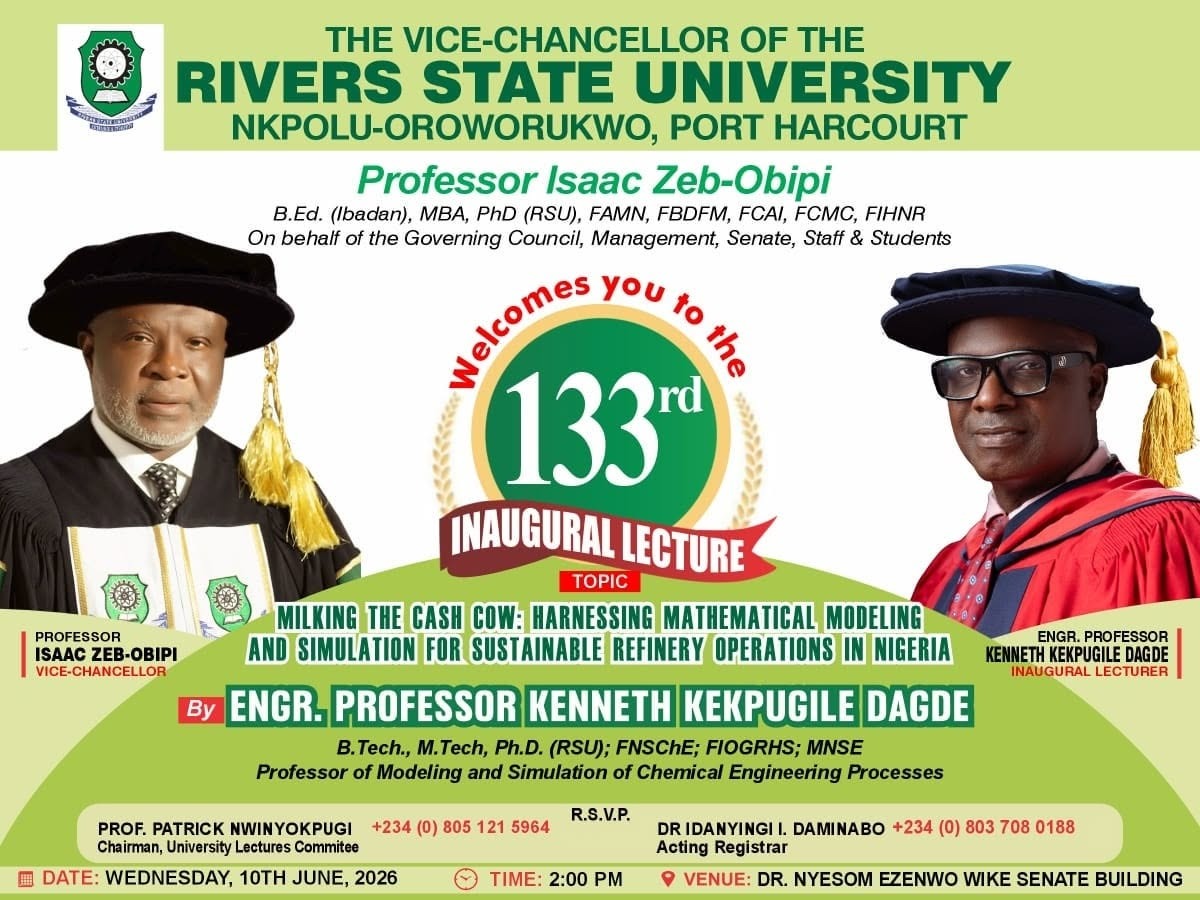
Prof. Dagde came out with this on Wednesday, June 10, 2026 while delivering the university’s 133rd Inaugural Lecture titled, “Milking the Cow: Harnessing Mathematical Modelling and Simulation for Sustainable Refinery Operation in Nigeria”, at its main campus in Nkpolu Oroworukwo, Port Harcourt.

He stated that such a model would allow government retain control while private operators handle day-to-day operations for efficiency, stressing that without critical upgrades, investments in the refinery would remain unproductive.
“The new Port Harcourt Refinery commissioned in 1989 has the fluid catalytic cracking unit, but what I have asked the government is, instead of repairing the new refinery, why should they go to the old refinery to repair?” he queried.
“The old refinery does not have reforming units, does not have hydro-cracking units and that’s why all the monies spent there is of no effect until now; and till tomorrow there will not be any progress except they incorporate the hydro-treating units and reforming units, then the products from there can be acceptable,” Dagde stated.

He further pointed out the obsolete nature of the facility’s technology, saying, “The technology there is also analogue. We recommend digital system in that old refinery.”
On ownership and management structure, he said: “Also they should privatise and then percentage of it be owned by government so that immediate action can be taken when necessary.
Additionally, the new refinery should not be outrightly sold. It should work like the NLNG arrangement. Government hand is in it but operated by private individuals and it is operating efficiently.”
The professor identified several factors hindering refinery performance in Nigeria, including government interference and inadequate crude supply.
“Some of the challenges of our refineries is government interference, lack of autonomy, poor maintenance culture, politicians recommended to do turnaround maintenance, and shortage of feed,” he said.
“Our crude oil is exported and then the refineries lack feed. And when equipment that was working no longer has feed making it redundant and equipments starts failing.”
To address this, he recommended structural reforms: “So all refineries both government or private should own their oil bloc for feed to be constantly in for refining.”
Dagde also proposed broader benefits for oil-producing regions, noting that, “States where crude oil is explored should own a refinery so that they can benefit from what comes from their land.”
Earlier, the Vice Chancellor of RSU, Professor Isaac Zep-Obipi, represented by the Deputy Vice Chancellor (Administration), Professor Blessing Jaja, underscored the importance of inaugural lectures in academia.

“For us as a university, the inaugural lecture is a very, very important and solemn event. It is so because we consider it an opportunity to demonstrate the quality of scholarship that takes place within the four walls of the citadel of learning,” he said.
“Secondly, we see it as an opportunity to enlighten the public, and by so doing contribute to a very important mission of our university, which is community service.
And thirdly, for us, it is a rite of passage for a professor in this school to share with us how his research is impacting not only his sphere of expertise, but how that research is helping to make society better.”


