
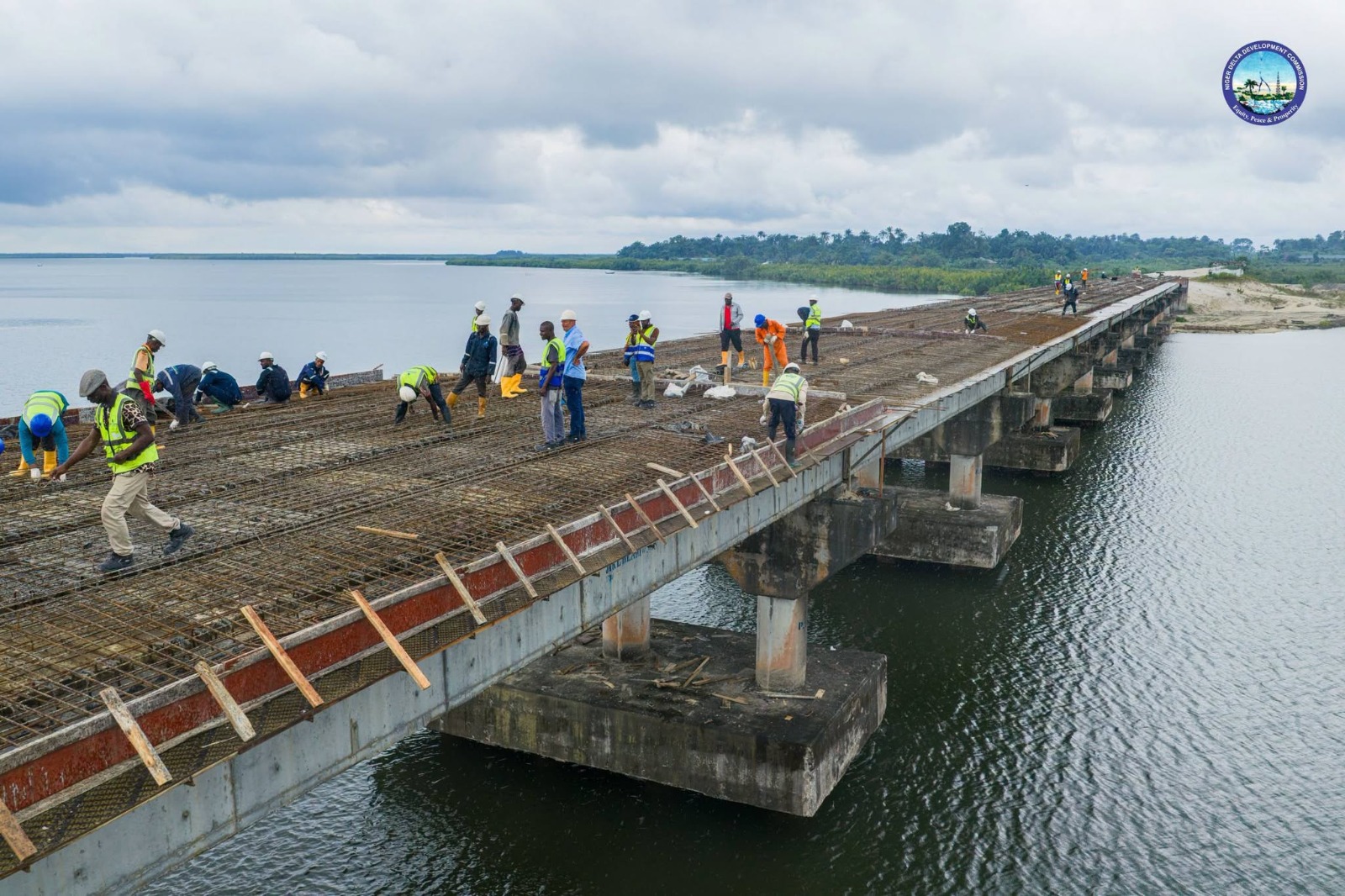
Kaa-Ataba Bridge: Andoni Communities Emerge from Decades of Isolation
For generations, residents of Ataba and neighbouring riverine communities in Andoni Local Government Area have depended on wooden boats to reach schools, hospitals, markets and other essential services.
Now, the construction of the Kaa-Ataba Road and Bridge project is offering them a long-awaited escape from decades of isolation.

Community leaders, traders and other beneficiaries say the Niger Delta Development Commission’s (NDDC) intervention will fundamentally change how people travel, conduct business, access public services and connect with neighbouring communities.
Linking Kaa in Khana Local Government Area with Ataba in Andoni, the project comprises a 1.2-kilometre main bridge, a 250-metre secondary bridge and a two-kilometre dual carriageway. Beyond its impressive engineering scale, residents say its greatest significance lies in the everyday difficulties it is expected to eliminate.
For the Head Chief of Ogogo Village, Chief John Ekwang, the project represents the fulfilment of a longstanding community aspiration. He described the bridge as the longest in the Niger Delta and said its construction had brought overwhelming relief to people who endured years of difficult and sometimes dangerous water transportation.
Ekwang recalled that schoolchildren had to risk river crossings to attend classes, while women and traders frequently suffered losses when fish and agricultural produce deteriorated during transportation.
“For many years, we cried for this bridge. Our children risked their lives crossing the river to go to school. Our women lost their fish and farm produce because there was no road. Today, NDDC has wiped our tears. This is the first time government has truly remembered us,” he said.

The benefits, he explained, extend beyond transportation to the safety of residents and the economic prospects of communities that have remained difficult to access.
He pledged the community’s support for the project, assuring that local youths would be mobilised to protect the infrastructure against vandalism and other forms of damage.
For the Chairman of the Ataba Elders Forum, ThankGod Egart, the bridge represents an opportunity to end the human and economic costs associated with dependence on boats.
He recalled the loss of lives and perishable goods under the old transportation arrangement, expressing optimism that the new road connection would make movement safer, improve access to education and enable traders to transport their produce to markets more efficiently.
“We have buried people waiting for boats. We have lost perishable goods. With this bridge, our children can now go to school and return safely. Our fish will reach Port Harcourt and Bori fresh. We thank President Bola Tinubu and the NDDC Board and Management for giving us this hope,” Egart said.
The impact is already being viewed through the prospects of improved earnings by local traders. Fish trader George Okop said the road connection had rekindled hope among fishing households that have struggled with high transportation costs and the difficulties of preserving their catches.
He noted that direct road access would reduce dependence on boats and the additional expense of buying ice to keep fish fresh while transporting them to major markets.
For fishing communities where income depends heavily on the speed and condition in which catches reach buyers, the prospect of a more reliable transportation link could make a significant difference to household earnings and the competitiveness of local produce.
The education sector is another area where residents anticipate substantial relief. A teacher from Ataba, Sarah Johnson, described travelling from the community to Port Harcourt as a major challenge, recalling that residents sometimes spent about two hours waiting for boats to cross the river to Kaa.
She said the bridge would ease the transportation burden, improve access to essential services and create better opportunities for residents, particularly students and families who have had to contend with the limitations of river-dependent mobility.
The expected transformation also has implications for healthcare delivery, emergency transportation, movement of agricultural products and commercial interaction between Andoni and Khana. Communities previously constrained by difficult water crossings could become more accessible to public services, businesses and development interventions.
For the NDDC, the Kaa-Ataba project is among the legacy infrastructure interventions being delivered by its current Board and Management, led by Chairman, Chiedu Ebie, and Managing Director, Dr Samuel Ogbuku, in alignment with President Bola Tinubu’s Renewed Hope Agenda.
But for the people on either side of the bridge, the significance is more immediate and personal: fewer dangerous journeys, reduced transportation difficulties, improved market access and a stronger connection to opportunities beyond their communities.
The real measure of the project will ultimately be seen in how effectively the new link improves daily life, stimulates local commerce and remains accessible and properly maintained.
After decades of waiting, Ataba and its neighbouring communities are looking beyond the river that once constrained their movement to a road connection they hope will open a new chapter of safety, mobility and economic opportunity.


