
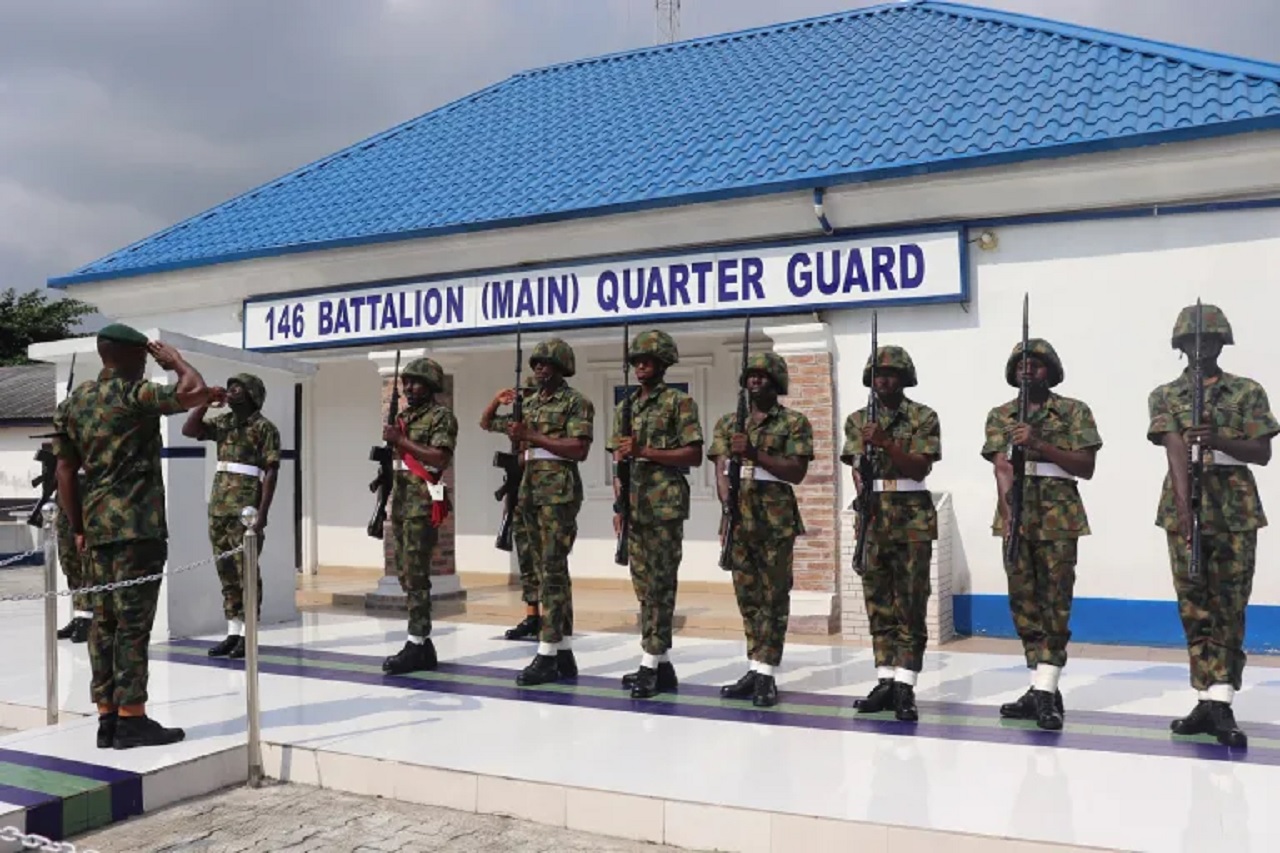
146 Battalion: Two Bases, One Formation
How successive commanders transformed Eburutu and Bonny into complementary military facilities—and how one of them became a critical bridge in that evolution.
The history of 146 Battalion, Nigerian Army, can be read through its operations, commanders and battlefields. But there is another, less obvious story: the physical evolution of one battalion across two locations separated by state boundaries but united by one command structure.
From Eburutu Military Cantonment in Calabar, Cross River State, to Lieutenant General Farouk Yahaya Camp in Bonny, Rivers State, successive commanders helped develop what has become a two-base formation—Eburutu providing institutional depth and Bonny providing forward operational reach.

It would, therefore, be inaccurate to describe 146 Battalion simply as a formation that relocated from Calabar to Bonny. It is more accurate to say that 146 Battalion grew around two complementary facilities. The roots are at Eburutu.
Eburutu: The Institutional Foundation
Eburutu was already an established military home of 146 Battalion long before Bonny became its dominant operational theatre. A Court of Appeal record relating to events at the cantonment in 2010 identifies the Commanding Officer of 146 Battalion, Eburutu Cantonment, Calabar, and describes the commander’s responsibility for the direction and general supervision of the cantonment. The record also demonstrates that the location had the characteristics of a functioning military community.
That foundation mattered. A battalion requires more than soldiers in the field. It needs accommodation, administration, schools, welfare, logistics, equipment, families and a functioning rear from which operations can be sustained.
For 146 Battalion, Eburutu provided that depth even as the operational demands of the Niger Delta increasingly pulled troops towards Bonny.
Bonny Emerges as The Forward Arm
As successive commanders assumed responsibility, the battalion’s operational footprint expanded.
Under Lt. Col. Lander Saraso, 146 Battalion was already undertaking significant operations around Bonny. In 2013, troops under his command were involved in the interception of the vessel Milandros at Bonny Anchorage during an operation against suspected oil theft.
The strategic logic was becoming clear. Eburutu was the rear; Bonny was becoming the frontline.
Bonny placed the Army closer to waterways, oil and gas infrastructure, export facilities and communities whose security was increasingly tied to the protection of Nigeria’s strategic economic assets.
The forward presence, therefore, needed to evolve from a temporary operational position into a properly developed military facility.
Habeeb Mbe: Strengthening Both Sides of the Formation

This is where Lt. Col. Habeeb Ibrahim Mbe deserves particular attention. His tenure appears to have been an important bridge between the older Eburutu-based institutional model and the modern Bonny-centred operational structure.
At Eburutu, Mbe undertook a series of practical interventions directed at the living and working conditions of soldiers and their families.
He renovated a three-classroom block at the Command Children School and provided classroom chairs for more than 80 pupils. He revived and renovated an abandoned water installation serving the soldiers’ quarters and sank two additional boreholes.
He also renovated the unit’s arms and magazine store and repeatedly refitted the Eburutu cantonment transformer during his tenure. His administration also sustained monthly allowances for widows living within the cantonment.
Taken together, these were not glamorous projects. They were the kind of interventions that determine whether a military cantonment actually functions effectively.
Mbe’s record at Eburutu therefore reinforces an important point: the development of Bonny did not mean neglect of the battalion’s Calabar foundation.
At Bonny, the mission was different. While Eburutu required institutional and welfare development, Bonny demanded operational intensity.
Mbe’s tenure involved numerous operations, including weapons recoveries and operations on the Bonny River and Cawthorne Channel, with the commander himself participating in both day and night operations.
His operational performance attracted recognition. He received commendation from the Division for outstanding operational conduct, infrastructural development and administration.
The Commander 6 Division Garrison, Brigadier General Edet Effiong, later publicly commended Mbe’s performance and described the transformation achieved at the Bonny camp in only months as remarkable. The higher command’s assessment was also reflected in the infrastructure that emerged under his watch.
In October 2023, Major General Jamal Abdussalam, then GOC 6 Division and Land Component Commander of Operation Delta Safe, commended Mbe for projects at the Bonny camp and said they created an enabling environment for troops to perform their duties.

The projects included an official residence for the Commanding Officer, officers’ transit accommodation, a remodelled officers’ mess and twin helipads, alongside a perimeter fence, entrance gate, quarter guard, 1.2-kilometre ring road, car park and mosque.
The camp was subsequently renamed Lieutenant General Farouk Yahaya Camp following approval by Army Headquarters.
Mbe himself acknowledged the strategic guidance and support of the higher command in bringing the projects to fruition. That distinction is important: the transformation was delivered under his command, but it was also a product of institutional support from the Army’s higher formations.
Mbe’s other achievement may have been less visible—but strategically important. Infrastructure could be built with concrete and steel. Community confidence was more difficult.
Bonny’s security environment contains a particularly delicate relationship between Bonny and Finima, and Mbe’s tenure coincided with several protests and community tensions.
According to the account of his tenure, Mbe deliberately invested in relations with youths from both communities and used those relationships to help contain protests and prevent community tensions from escalating into wider security problems.
That community dimension became important to the physical expansion of the Army’s Bonny facility. Mbe was involved in securing approximately one hectare of land from Finima Community for future expansion of Farouk Yahaya Camp.
He also ensured that the old camp and the newly acquired parcel were surveyed and registered in the Nigerian Army’s name. The significance goes beyond the acreage.
In a sensitive traditional and community environment, acquiring land for a military installation requires more than engineering. It requires negotiation, trust and the management of competing community interests. Mbe’s tenure therefore linked community relations to military infrastructure development.
He subsequently oversaw the construction of an approximately one-kilometre road linking the newly acquired Army land with the new NLNG Train 7 Workers Village, presenting the road not only as an Army requirement but also as part of the battalion’s community-development effort.
Industry also noticed the difference. The operational relationship between 146 Battalion and the oil and gas industry became another measure of the command’s effectiveness.
Mbe’s tenure attracted commendation from Shell Petroleum Development Company for effective operations and for providing a conducive security environment for the company’s activities, while NLNG reportedly recommended him for a Chief of Army Staff commendation award for outstanding performance in command.
These recognitions fit into the wider strategic mission that later became even more visible under his successor.
In October 2024, Defence Minister, Mohammed Badaru visited 146 Battalion Main in Bonny and commended the formation for protecting critical national infrastructure, particularly the Trans-Niger Pipeline, while urging troops to sustain operations against oil theft, illegal refining and economic sabotage.
Oyewumi Inherited Two Functioning Sides of The Same Battalion
When Lt. Col. Oyemade Ade Oyewumi succeeded Mbe in 2024, he inherited something much more substantial than the battalion his predecessors had known. He inherited an operational headquarters in Bonny and an established rear base at Eburutu. And he continued developing both.
At Eburutu, his administration delivered extensive infrastructure, including 215 solar streetlights, improvements to gates and guard posts, reconstruction of the headquarters road, boreholes and overhead tanks for soldiers’ accommodation, renovation of Block 24, bus stops, headquarters refurbishment and electrification of the Mammy Market.
His administration also strengthened the social relationship between the military and the barracks community through the Barracks Youths’ Get-Together, which reached its third edition in December 2025.
Meanwhile, the Bonny headquarters continued its strategic mission of protecting pipelines, oil and gas installations and other critical national infrastructure. By the end of Oyewumi’s tour, the two-base structure was no longer merely an historical arrangement. It was an established organisational reality.
During the transition to his successor, the outgoing commander took the incoming Ccommanding Officer, Lt Col David Danladi Omale around both Battalion Main at Farouk Yahaya Camp, Bonny, and Battalion Rear at Eburutu Military Cantonment, Calabar, including the facilities and operational commitments attached to both locations.
What Successive Commanders Actually Built
The achievement of 146 Battalion therefore cannot reasonably be credited to one commander. The early commanders inherited and sustained Eburutu. Others increasingly projected the battalion into the Bonny operational environment.
Commanders such as Wuyep continued the emphasis on readiness, welfare and infrastructure.
Mbe was particularly significant because he worked on both sides of the equation: improving the living and institutional conditions at Eburutu while simultaneously strengthening the operational, infrastructural and community foundations of the Bonny base.
Oyewumi inherited that platform and extended the infrastructure and welfare programme at Eburutu while maintaining Bonny’s role as the battalion’s strategic forward headquarters. The result is a formation with depth behind it and reach in front of it.
One Battalion, Two Bases, One Mission
There is a temptation to view Eburutu and Bonny as competing centres of gravity. They are better understood as complementary. Eburutu provides institutional depth. Bonny provides operational reach.
One sustains the people and administrative machinery of the battalion; the other puts soldiers close to the waterways, communities, pipelines, oil and gas facilities and other strategic assets they are tasked to protect.
This architecture is itself a product of military continuity. Buildings can be commissioned in a day, but formations are built over years.
The story of 146 Battalion is therefore ultimately the story of successive commanders taking an inherited institution, understanding the changing security environment and adding another layer—operations, infrastructure, welfare, community relations, logistics, critical-infrastructure protection or professional administration.
From Eburutu to Bonny, they did not build two battalions. They collectively built one formation capable of operating from two strategic locations.
And that may be one of the most important reasons 146 Battalion has evolved into a significant land-security component of the wider Niger Delta and Bonny security architecture.


