
2027 Elections: INEC Targets Increased Participation of Persons With Disabilities
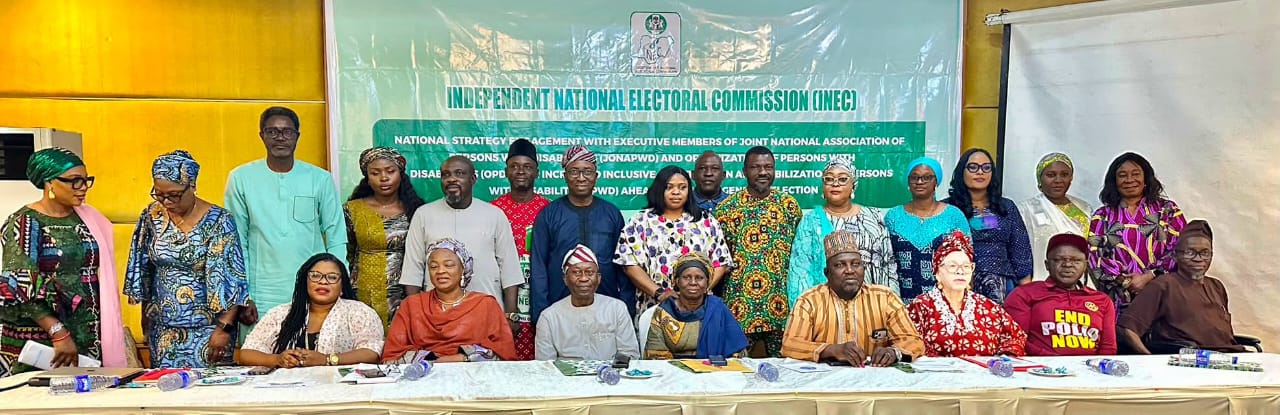
The Independent National Electoral Commission, (INEC), has commenced strategic engagement with the Joint National Association of Persons with Disabilities, (JONAPWD), Organisations of Persons with Disabilities and cluster heads, as part of efforts to increase the participation of Persons with Disabilities (PWD) in the 2027 general elections.
The engagement, which focused on sensitisation and mobilisation, is aimed at ensuring that eligible voters with disabilities are adequately informed, effectively reached and meaningfully involved at every stage of the electoral process.

Representing the INEC Chairman, Professor Joash Amupitan, the Acting Chairman of the Commission, Professor Rhoda Gumus, said the engagement was timely as preparations for the 2027 elections gather momentum.
Gumus said INEC is committed to building an electoral process that is inclusive, accessible, participatory and responsive to the needs of all eligible citizens. She cited Section 54 of the Electoral Act 2026, the Discrimination Against Persons with Disabilities (Prohibition) Act 2018, and INEC’s Framework on Access and Participation of Persons with Disabilities in the Electoral Process as key legal and policy instruments supporting PWD participation.
The Acting Chairman stressed the need for innovative voter education approaches, including disability-specific communication channels, community-based organisations, radio, social media and other assistive formats.

INEC disclosed that its available data, compiled before the introduction of the Automated Fingerprint Identification System, recorded 137,487 Persons with Disabilities. The figure comprises 13,080 visually impaired persons, 9,299 hearing-impaired persons, 30,561 persons with albinism, 19,430 persons with physical impairments and 54,941 persons under other disability categories.
Gumus urged JONAPWD and Organisations of Persons with Disabilities to take ownership of the sensitisation process by reaching their members with information on voter registration, Permanent Voter Card collection, voting procedures, accessibility measures and other aspects of the electoral process. She said the engagement would enable stakeholders to identify barriers to participation, share successful strategies and agree on practical actions to be implemented before, during and after the 2027 elections.

The Director of Gender and Inclusivity at INEC, Lakunuya Bello, highlighted measures already introduced by the Commission to improve accessibility, including Braille ballot guides, magnifying glasses, the EC30 PWD form and sign-language interpretation during collation activities. Bello added that the outcome of the national engagement would be replicated at the state level through Resident Electoral Commissioners, Electoral Officers and other relevant officials to ensure that agreed strategies translate into grassroots interventions.
The National President of JONAPWD, Abdullahi Usman, commended INEC for organising the engagement but called for broader and more strategic consultations involving more disability stakeholders. Usman said such engagements would enable Persons with Disabilities to communicate their needs, identify gaps and propose solutions capable of improving their participation in elections.
Also speaking, the Executive Secretary of the National Commission for Persons with Disabilities, Ayuba Burki, said the exact number of Nigerians living with disabilities remained difficult to determine, but noted that the population was substantial. Burki called for stronger collaboration among stakeholders to ensure that Nigerians with disabilities could participate fully in the democratic process.

Also speaking, the Founder and Chief Executive Officer of TAF Africa, Jake Epelle, described the engagement as timely, stressing that an election that fails to include the voices of Persons with Disabilities cannot be regarded as fully democratic. Epelle commended INEC’s progress in implementing priority voting, which he said had been consistently achieved during recent off-cycle elections. He, however, urged the Commission to extend similar progress to polling-unit accessibility and strategic voter education.
The Deputy Director of Inclusivity at INEC, Habiba Jatto, said the engagement was designed to strengthen collaboration among INEC, JONAPWD, OPDs, cluster heads and other stakeholders; increase PVC collection and voter turnout among PWDs; promote awareness of electoral rights; identify barriers to participation; improve voter education in accessible formats; and ensure that no eligible voter is excluded because of disability.

The engagement followed a strategic discussion on the sensitisation and mobilisation of Persons with Disabilities led by the Executive Director of the Inclusive Friends Association, Grace Jerry.
The meeting concluded with INEC directors and other internal stakeholders reaffirming the need for sustained collaboration with disability organisations and relevant bodies to promote accessible voter education, remove barriers and support the full and meaningful participation of Persons with Disabilities in the electoral process.


